
3M 🕒
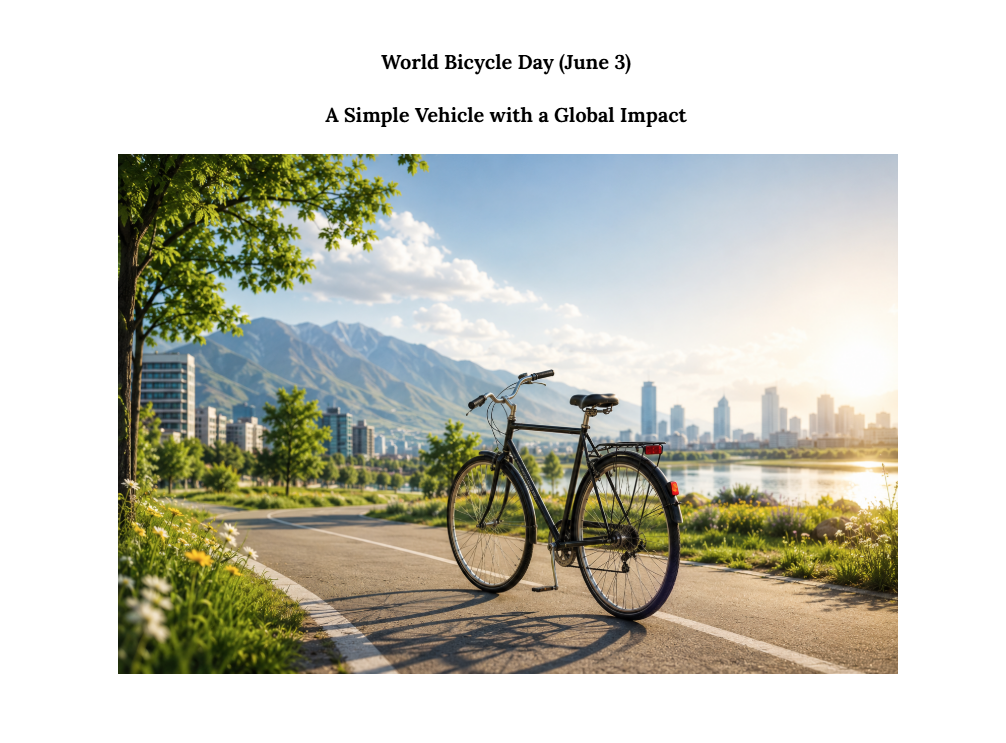
On World Bicycle Day, the international community recognizes the bicycle as a simple, affordable, reliable, clean, and environmentally sustainable means of transportation.
In April 2018, the United Nations General Assembly officially designated June 3 as World Bicycle Day through Resolution A/RES/72/272. The resolution acknowledged the bicycle not only as a means of transportation, but also as a tool that supports health, education, social inclusion, and sustainable development. In 2022, the UN General Assembly adopted another resolution encouraging governments to integrate cycling into public transportation systems and urban planning.
The United Nations and the World Health Organization emphasize that cycling contributes directly or indirectly to many Sustainable Development Goals. Regular bicycle use can improve physical and mental health, reduce traffic congestion, lower greenhouse gas emissions, and improve air quality in urban areas.
Transportation remains one of the largest contributors to climate change worldwide. According to the United Nations, the transport sector is responsible for nearly one quarter of global greenhouse gas emissions, while more than 95 percent of transportation energy still comes from fossil fuels. Expanding bicycle use is therefore not only a transportation issue, but also part of the global response to climate change and environmental degradation.
At the same time, bicycles can make cities more accessible and equitable. In many communities, especially among lower-income populations, bicycles provide one of the most affordable forms of mobility and access to education, employment, and social participation.
Yet the significance of bicycles extends beyond transportation and economics.
The bicycle invites us to rethink our relationship with energy consumption, urban life, and the environment. It reminds us that not every challenge requires a complicated technological solution. Sometimes healthier and more sustainable communities begin with simpler daily choices.
Cities designed only around automobiles often become noisier, more polluted, and less humane. Cities that create safe spaces for walking and cycling tend to be healthier, more inclusive, and more environmentally sustainable.
World Bicycle Day is therefore not only about bicycles. It is about cleaner air, healthier lifestyles, responsible use of resources, and greater respect for both people and the Earth we share.
Protecting the environment often begins with ordinary daily decisions. Choosing how we move from one place to another is one of those decisions.