
Nelson Mandela International Day – 18 July
Nelson Mandela is remembered for many reasons. He led one of history’s most remarkable struggles against racial injustice. He endured twenty-seven years of imprisonment without abandoning his commitment to freedom. He guided South Africa through a peaceful democratic transition at a moment when many feared civil war. Above all, he demonstrated that justice and reconciliation are not opposing ideals but mutually reinforcing principles.
These achievements have rightly become central to Mandela’s global legacy, and they continue to offer valuable lessons for societies striving for peace, equality, human dignity, and democratic governance.
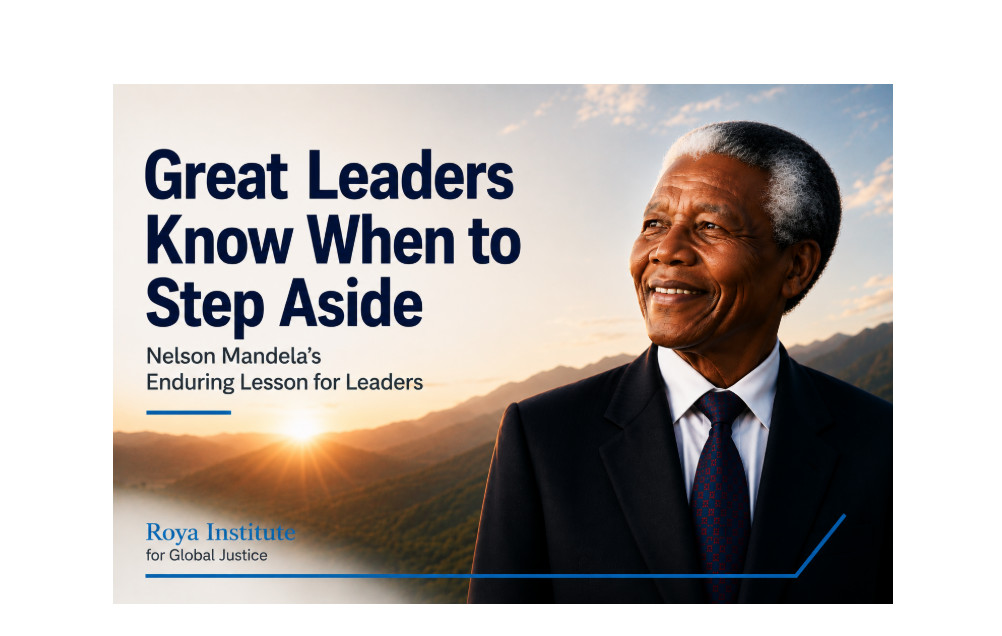
Yet one defining aspect of Mandela’s leadership receives far less attention. It was not a speech, a negotiation, or a political victory. It was his decision, at the height of his popularity, not to seek a second presidential term.
That decision may be one of the most enduring lessons Mandela offers to today’s leaders.
At the height of his popularity—both in South Africa and around the world—Mandela voluntarily stepped away from power. He understood a truth that many leaders forget: the strength of a democracy depends not on the longevity of its leaders, but on the resilience of its institutions.
History offers many examples of leaders who sought to remain in office by weakening democratic institutions, changing constitutions, postponing elections, or concentrating authority in their own hands. Mandela chose a different path. He demonstrated that leadership is ultimately measured not by how long one holds power, but by the institutions one leaves behind and the people one prepares to lead.
His decision reflected remarkable humility. It takes courage to win power, but it often takes even greater courage to relinquish it voluntarily. By stepping aside, Mandela reaffirmed a fundamental democratic principle: no individual is greater than the institutions that serve the public.
This lesson extends far beyond politics. Universities, courts, civil society organizations, businesses, and community institutions all become stronger when leadership encourages participation, accountability, renewal, and the development of future leaders. Lasting institutions are built by leaders who invest in successors rather than in personal authority.
Mandela’s example also challenges a common misunderstanding about leadership. Influence is not measured by the number of years someone remains in office. It is measured by the trust they earn, the values they uphold, the institutions they strengthen, and the opportunities they create for others.
Today, many societies face growing political polarization, declining public trust, and increasing pressure on democratic institutions. In such times, Mandela’s legacy reminds us that ethical leadership is not simply about exercising authority. It is about serving the public, respecting constitutional limits, accepting accountability, and knowing when leadership requires stepping aside.
At the same time, Mandela never viewed leadership as passive restraint. He combined moral courage with practical wisdom, conviction with dialogue, and determination with compassion. His willingness to forgive did not mean abandoning justice; rather, it reflected his belief that lasting peace requires both accountability and reconciliation.
On Nelson Mandela International Day, the United Nations encourages people around the world to dedicate 67 minutes to serving others, symbolizing the 67 years that Mandela devoted to public service. This invitation reminds us that leadership is not confined to public office. Every act of service—whether mentoring a young person, supporting a neighbour, volunteering in the community, or standing against injustice—helps strengthen the bonds that hold societies together.
At Roya Institute for Global Justice, we believe that just societies require more than sound laws and effective institutions. They also require ethical leadership grounded in integrity, humility, responsibility, and service. Mandela’s life reminds us that leadership reaches its highest purpose when it empowers others rather than elevates oneself.
Perhaps Nelson Mandela’s greatest legacy is this: lasting justice is built not by indispensable leaders, but by strong institutions that enable ordinary people to accomplish extraordinary things together.
As we commemorate Nelson Mandela International Day, may Mandela’s example inspire today’s and tomorrow’s leaders to remember that the true measure of leadership is not how long one holds power, but how responsibly one exercises it, how willingly one shares it, and how gracefully one lets it go.
References
Mandela, Nelson. Long Walk to Freedom. Boston: Little, Brown and Company, 1994.
United Nations. Nelson Mandela International Day. https://www.un.org/en/observances/mandela-day
Nelson Mandela Foundation. Mandela Day – Take Action. Inspire Change. https://www.mandeladay.com/