
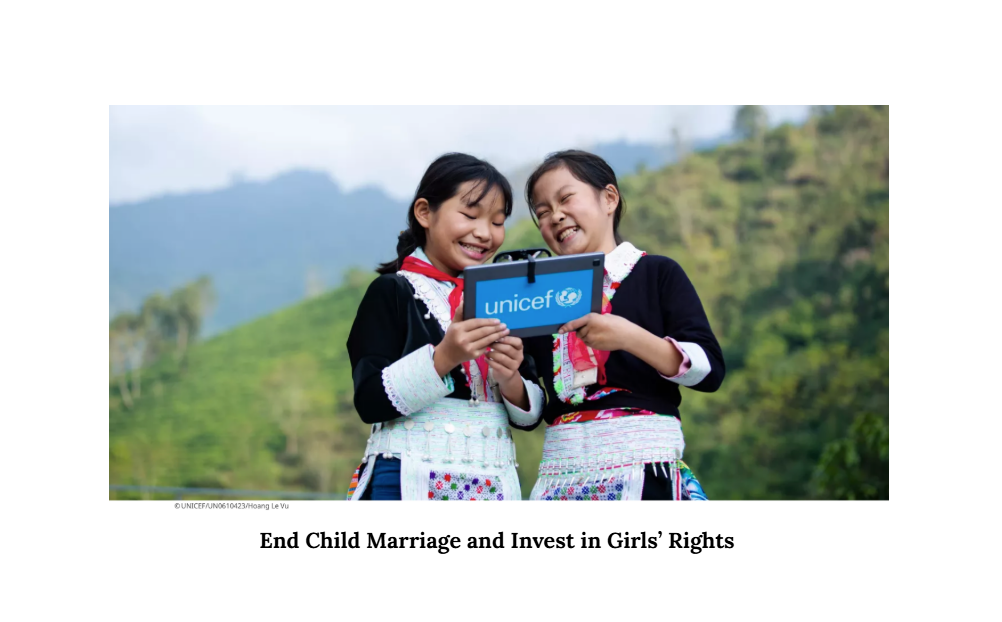
End Child Marriage and Invest in Girls’ Rights
Observed annually on October 11, the International Day of the Girl Child offers an opportunity to amplify girls’ voices, celebrate their leadership and potential, and draw global attention to the discrimination and challenges that continue to restrict the rights, freedom, and future of millions of girls.
The 2026 theme, “End Child Marriage and Invest in Girls’ Rights,” focuses on one of the most widespread violations of girls’ rights. It reminds us that ending child marriage requires more than legislation. Governments and communities must also invest in girls’ education, health, safety, participation, leadership, and economic opportunities.
Every three seconds, somewhere in the world, a girl is married before reaching adulthood. Today, one in five girls worldwide is married before the age of 18—placing her education, health, safety, freedom, and future at risk.
On the International Day of the Girl, Roya Institute for Global Justice joins the United Nations in calling for urgent and sustained action to end child marriage and defend every girl’s right to a safe childhood.
Child marriage is not merely a private or family matter. It is a serious human rights concern that can deprive girls of education, expose them to violence and exploitation, undermine their physical and mental health, and deny them the opportunity to make free and informed decisions about their lives. Meaningful consent cannot exist where a child lacks the legal capacity, independence, or practical freedom to choose.
Poverty remains a major driver of child marriage. The risks become even greater during armed conflict, forced displacement, climate-related disasters, and economic crises, when families may lose access to education, income, social protection, and essential services. Girls living in marginalized communities, refugee and displaced girls, and girls with disabilities often face additional and overlapping forms of vulnerability.
Progress is possible. Over the past 25 years, efforts to keep girls in school, improve families’ economic opportunities, strengthen legal and social protections, and challenge discriminatory gender norms have helped prevent an estimated 68 million child marriages. These achievements demonstrate that coordinated and adequately funded action can bring meaningful change.
Yet progress cannot be taken for granted. Reductions in domestic and international funding threaten programs that protect girls, support their education, and assist vulnerable families. Governments and institutions must treat investment in girls not as optional charity, but as a legal, ethical, and social responsibility.
Effective action requires:
- Establishing and enforcing 18 as the minimum legal age for marriage, without discriminatory exceptions;
- Ensuring universal birth and marriage registration;
- Keeping girls in safe, accessible, and high-quality education;
- Expanding economic and social protections for families facing poverty and crisis;
- Providing girls with appropriate health, legal, and psychosocial services;
- Working respectfully with parents, educators, religious and community leaders, and young people to challenge harmful practices;
- Supporting girls who are already married, separated, widowed, or at risk, without stigma or exclusion; and
- Listening directly to girls and including them meaningfully in decisions affecting their lives.
Girls must be recognized not only as people in need of protection, but also as rights-holders, leaders, and agents of change. Policies concerning girls should be developed with them, not merely for them.
As United Nations Secretary-General António Guterres has urged, we must “defend the right of all girls to a childhood.” Protecting that right requires determined legal action, sustained resources, community engagement, and a shared commitment to ensuring that every girl can learn, grow, participate, and shape her own future.
Roya Institute for Global Justice calls upon governments, international organizations, educational institutions, civil society, faith communities, and individuals to renew their commitment to ending child marriage and removing every barrier that prevents girls from living with freedom, safety, equality, and dignity.
For more information, visit the United Nations page on the International Day of the Girl Child.