
⏰3
With the adoption of this day by the United Nations, August 30 was designated as the International Day of the Victims of Enforced Disappearances. This horrific phenomenon constitutes a grave violation of human rights, plunging families and communities into anguish and uncertainty. Enforced disappearance is often used to intimidate political opponents or control populations, depriving victims of legal protection. It not only tramples on individual rights but also represents a global challenge that demands collective resistance.
The United Nations, in order to avoid politicization, generally refrains from naming countries where this crime is widespread, choosing instead to highlight overall figures. However, based on informal UN reports and findings by human rights organizations such as Amnesty International and Human Rights Watch, in recent decades the highest rates of enforced disappearances have been recorded in countries across Latin America, Asia, and the Middle East, often due to military dictatorships or internal conflicts.
Some countries repeatedly mentioned in such reports include:
- Syria: due to the civil war and the systematic use of enforced disappearance by the state and armed groups.
- Iraq: linked to internal conflict, terrorism, and militia activities.
- Algeria: particularly during the civil war of the 1990s.
- Chile and Argentina: during the military dictatorships of the 1970s and 1980s.
- Afghanistan: as a result of decades of conflict and political instability.
- Bosnia and Herzegovina – during the 1990s conflict, when thousands of Muslims went missing as a result of ethnic violence and war crimes.
These are only examples, not an exhaustive list. In many countries, deliberate state secrecy makes it impossible to obtain accurate statistics.
Enforced disappearance violates a wide range of rights of both victims and their families, including:
- The right to liberty and security of person: victims are abducted and detained without legal process.
- The right to a fair trial and freedom from torture: detainees are often held in secret facilities without access to lawyers or courts, and are at high risk of torture and ill-treatment.
- The right to life: many enforced disappearances ultimately result in extrajudicial killings.
- The rights of families: relatives are denied knowledge of their loved ones’ fate and suffer ongoing psychological, financial, and social trauma—amounting to a violation of their right to be free from cruel or inhuman treatment.
- Civil and political rights: enforced disappearances are systematically used to silence opposition and restrict civic and political activity.
The practice of enforced disappearances dates back to the 20th century, particularly during civil wars and dictatorships. In recent decades, however, it has become a widespread tool of political repression in various regions. According to UN reports, enforced disappearances have been documented in more than 110 countries worldwide. This crime is not limited to times of armed conflict—it is widely used even in times of peace as a weapon of fear and intimidation.
Roya Institute emphasizes the urgent need for accountability, justice, and support for victims and their families. We believe no one should remain alone in this darkness, and that through cooperation between human rights organizations, civil society, and international institutions, we must work to end this criminal practice.
We call on all states to ratify and fully implement the International Convention for the Protection of All Persons from Enforced Disappearance. Only then can we prevent the recurrence of such crimes, restore the dignity of victims, deliver justice to them and their families, and ensure that perpetrators are held accountable and subjected to transparent and fair judicial processes.
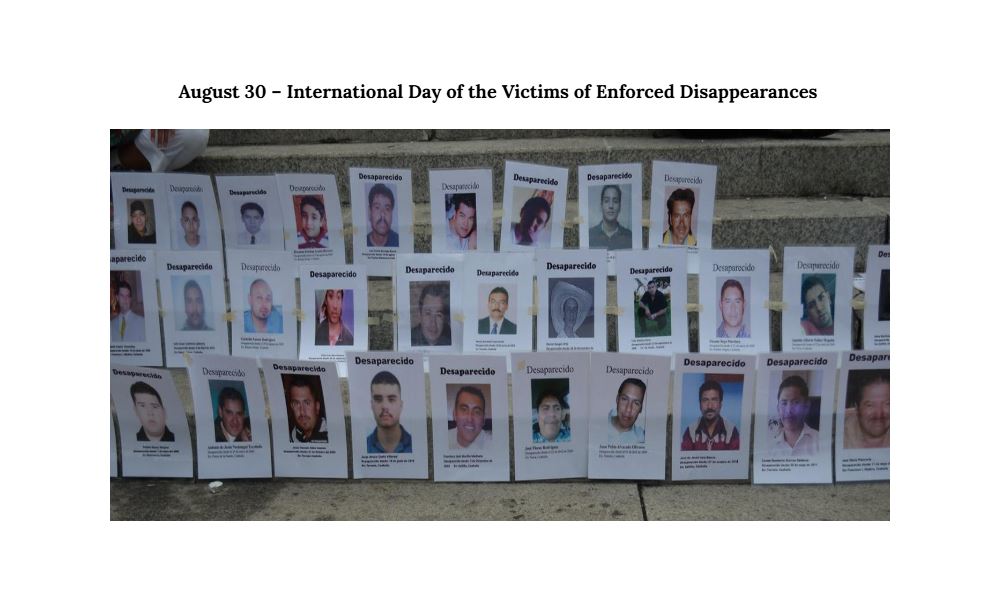
Photo description:
The families and friends of the victims experience slow mental anguish, not knowing whether the victim is still alive and, if so, where he or she is being held, under what conditions, and in what state of health./ PHOTO:OHCHR Mexcio