
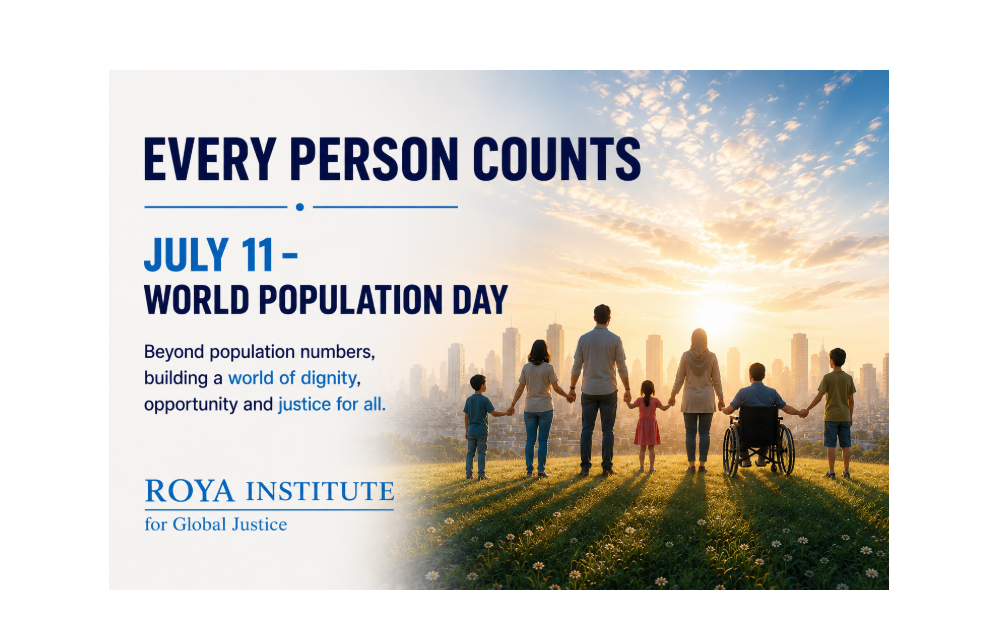
More than eight billion people now share our planet. Yet the defining challenge of our time is not simply the size of the world’s population—it is whether every person has the opportunity to live with dignity, security, and hope.
World Population Day invites us to look beyond demographic statistics and ask deeper questions. Are children receiving quality education? Do families have access to healthcare? Can young people find meaningful employment? Are women and girls able to exercise their rights and reach their full potential? Can communities thrive while protecting the natural environment for future generations?
Population figures alone cannot answer these questions. A nation may experience rapid population growth or demographic decline, but neither trend determines its future by itself. The true measure of progress lies in how societies invest in people, expand opportunities, strengthen institutions, and protect human dignity.
Throughout history, human beings have been recognized not merely as economic resources or demographic units, but as individuals possessing inherent worth. Every person carries unique talents, aspirations, and the capacity to contribute to society. When people are denied education, healthcare, decent work, or equal opportunities, humanity loses far more than economic productivity—it loses creativity, resilience, and hope.
This perspective is reflected in the United Nations Sustainable Development Goals, which recognize that sustainable development requires progress across many interconnected areas, including poverty reduction, quality education, gender equality, good health, environmental sustainability, and peaceful, inclusive societies. Population policies are most effective when they place human well-being at their center rather than treating people as numbers to be managed.
Today’s demographic realities also highlight growing inequalities. While some societies face aging populations and declining birth rates, others continue to experience rapid population growth accompanied by limited access to education, healthcare, employment, and public services. These challenges cannot be addressed through demographic policies alone. They require inclusive governance, long-term investment, international cooperation, and a commitment to social justice.
Climate change, forced displacement, conflict, and widening economic inequality further demonstrate that humanity’s greatest challenges are not caused by population itself. They result from unequal access to resources, unsustainable patterns of development, discrimination, and weak institutions. Building resilient societies therefore depends less on how many people inhabit the planet than on how fairly opportunities and responsibilities are shared.
At Roya Institute for Global Justice, we believe that every human being possesses equal dignity and deserves the opportunity to flourish. Sustainable societies are built not by managing population numbers alone, but by investing in people—their education, health, rights, creativity, and participation in public life. Development succeeds when every person is recognized as both a rights-holder and a contributor to the common good.
World Population Day reminds us that every statistic represents a human life, every number tells a personal story, and every individual has the potential to shape a more just and peaceful world. Looking beyond population numbers allows us to focus on what truly matters: creating conditions in which all people can live with dignity, realize their potential, and contribute to the well-being of future generations.
Call to Action
On this World Population Day, let us look beyond demographic statistics and reaffirm a simple principle: every person counts because every person possesses inherent dignity. By supporting education, promoting equal opportunities, protecting human rights, strengthening inclusive institutions, and advancing sustainable development, each of us can help build societies where every individual has the opportunity to thrive.
References
- United Nations. World Population Day.
https://www.un.org/en/observances/world-population-day - United Nations Population Fund (UNFPA). World Population Day.
https://www.unfpa.org/world-population-day - United Nations. Transforming Our World: The 2030 Agenda for Sustainable Development.
https://sdgs.un.org/2030agenda