
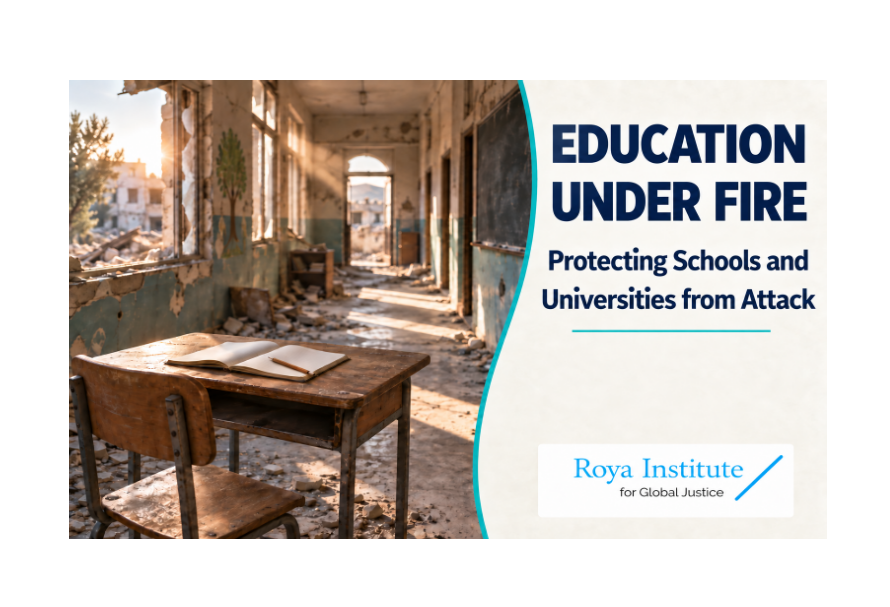
Education is a fundamental human right and a gateway to many other rights, including participation in society, freedom of expression, development, and a life of dignity. The Universal Declaration of Human Rights, the International Covenant on Economic, Social and Cultural Rights, and the Convention on the Rights of the Child all affirm the right to education.
As armed conflicts increasingly affect schools and universities, this fundamental right faces a grave threat in many parts of the world. In 2020, through Resolution 74/275, the United Nations General Assembly designated September 9 as the International Day to Protect Education from Attack. The observance draws global attention to the plight of schoolchildren, university students, teachers, professors, and education personnel. It also underscores the responsibility of states and parties to armed conflicts to protect education during emergencies and warfare.
A Widespread and Growing Crisis
According to Education Under Attack 2026, at least 8,566 attacks on education or incidents involving the military use of educational facilities occurred during 2024 and 2025—a rise of more than 40 percent compared with the previous two-year period. At least 10,600 schoolchildren, university students, teachers, professors, and education personnel were killed, injured, abducted, arrested, or otherwise harmed. Attacks affecting education were reported in 83 countries.
The consequences reach far beyond the destruction of a school or university building. Death and injury, interrupted learning, displacement, psychological trauma, school dropout, and lost opportunities can affect an entire generation and those that follow. Girls, women, children with disabilities, and marginalized communities often bear a disproportionate share of these harms.
During crises, education is not merely a public service. It can provide safety, psychological stability, access to essential information, and continued connection with the community. UNESCO therefore recognizes education both as a fundamental human right and as a force that empowers individuals and strengthens peaceful and inclusive societies.
Protecting Education Under International Law
Under international humanitarian law, schools and universities are presumed to be civilian objects and must not be attacked. Schoolchildren, university students, teachers, and professors are also protected as civilians unless and for such time as they directly participate in hostilities.
This civilian protection is not absolute. An educational facility may lose its protection from attack only when its use meets the strict legal criteria for classification as a military objective—and only for as long as those conditions remain. Even then, parties to a conflict must comply with the principles of distinction and proportionality and take all feasible precautions to minimize civilian harm. The International Committee of the Red Cross emphasizes that direct attacks against civilians and civilian objects, including schools, are prohibited.
Using schools or universities as military bases, barracks, weapons-storage sites, detention facilities, or observation posts disrupts education and exposes students and education personnel to serious danger. Contrary to a common misconception, military use does not automatically make every educational facility a lawful military target. Each case must be assessed against the strict requirements of international humanitarian law.
The Safe Schools Declaration
The Safe Schools Declaration is one of the leading international frameworks for reducing the impact of armed conflict on education. Championed by Norway and Argentina, it was opened for endorsement by states in 2015.
The Declaration is not a legally binding treaty but an intergovernmental political commitment. By endorsing it, states pledge to investigate attacks on education, promote the continuation of learning during armed conflict, and take practical measures to prevent or reduce the military use of schools and universities. Its accompanying guidelines offer concrete guidance for restricting the use of educational institutions for military purposes during armed conflict.
A Shared Responsibility to Protect the Future
Protecting education requires coordinated action. States should align their domestic laws and military policies with international obligations, independently investigate attacks, and hold those responsible for serious violations accountable. All parties to armed conflicts should refrain from attacking students, teachers, and educational institutions and from using schools and universities for military purposes.
International organizations and donors should prioritize education in emergencies, the reconstruction of damaged institutions, and psychological and social support for survivors. Local communities and educational institutions can also help reduce risks by developing emergency plans, creating safer routes to school, providing alternative forms of learning, and documenting violations. Primary responsibility for protection, however, remains with states and parties to armed conflicts.
September 9 reminds us that no war should deprive a generation of education. Protecting a school or university means more than preserving a building; it means safeguarding lives, dignity, hope, and the future of a community. Education is a foundation of lasting peace, and protecting it means protecting our shared human future.