
⏰3
The International Day of Charity was established to sensitize and mobilize people, NGOs, and stakeholders around the world to help others through volunteer and philanthropic activities. The date of 5 September was chosen to commemorate the passing of Mother Teresa of Calcutta, who received the Nobel Peace Prize in 1979 “for work undertaken in the struggle to overcome poverty and distress, which also constitute a threat to peace.”
The Power of Charity in Global Solidarity
At its core, charity is an expression of global solidarity. It brings people together to build more just and resilient societies—whether through direct giving, volunteering, or collective action. Beyond immediate aid, charity strengthens healthcare, education, cultural preservation, and the protection of vulnerable groups. Today, both charity and philanthropy are evolving to address the deeper causes of poverty and inequality.
Charitable efforts now influence public policy, fund innovation, and support communities where public services fall short. In fragile regions, they often fill critical gaps where governments cannot.
The United Nations 2030 Agenda for Sustainable Development places the eradication of poverty in all its dimensions at the center of the global mission. Poverty is not merely a lack of income; it also encompasses hunger, exclusion, unsafe living conditions, and limited access to education or healthcare. Achieving the Sustainable Development Goals (SDGs) requires strong partnerships between governments, civil society, businesses, and charitable organizations working together.
Charity in History and Tradition
Charity has long been one of the most powerful engines for building humane and resilient societies. Across history, many institutions that serve humanity at their best—universities, research centers, places of worship, libraries, and hospitals—were established through charitable giving.
In the Islamic tradition, waqf (endowment) is a profound example of sustainable charity, ensuring that contributions remain impactful across generations by continuing to provide education, healthcare, knowledge, and spiritual growth for all.
A World in Urgent Need
Today, the need for charity is greater than ever. According to the Global Peace Index 2025 (Institute for Economics and Peace, Sydney, August 2025), the global peace score has declined for the 13th time in 17 years. With 59 active armed conflicts—the highest number since World War II—and record-high global military expenditures of $2.7 trillion in 2024, the world devotes vast resources to violence even as humanitarian needs reach record levels. The economic impact of violence is estimated at nearly $20 trillion—equivalent to 11.6% of global GDP.
In such a world, humanitarian assistance is indispensable. Millions of people in Gaza, Sudan, Afghanistan, and many other regions depend on aid for food, medicine, and shelter. Yet charity alone is not enough. To uphold human dignity and justice, we must also work to eliminate the root causes of vulnerability. While natural disasters such as earthquakes may be beyond human control, the greatest drivers of displacement, hunger, and human suffering are man-made: wars and armed conflicts.
This is why the global community must recognize that without curbing the production and spread of weapons—especially weapons of mass destruction and other non-conventional arms—the cycle of violence will only intensify. More wars will mean more devastation, more displaced populations, and an ever-growing need for humanitarian aid.
Conclusion: Charity for Justice and Peace
On this International Day of Charity, the Roya Institute calls for a vision of charity that goes beyond immediate relief. We must continue to support those in urgent need while also striving for structural peace: reducing arms production, fostering dialogue, addressing inequality, and strengthening the social foundations that prevent future crises.
True charity is not only about giving generously—it is also about working collectively to build a world where fewer people need to rely on aid to survive.
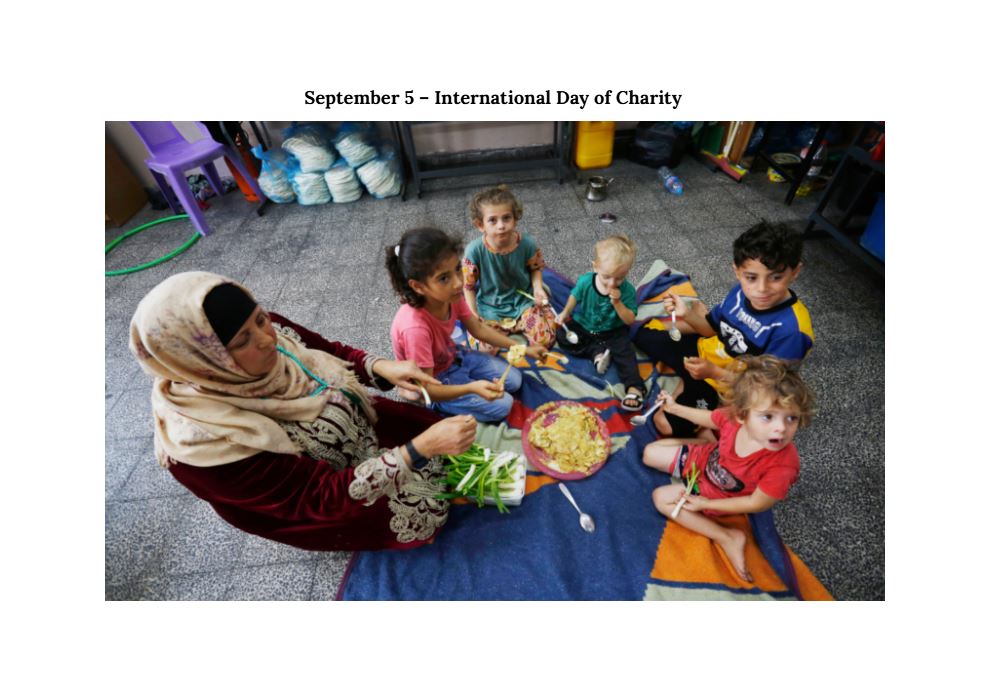
Photo description: A displaced family sharing a meal © UNRWA Photo by Ashraf Amra, October 2023,