
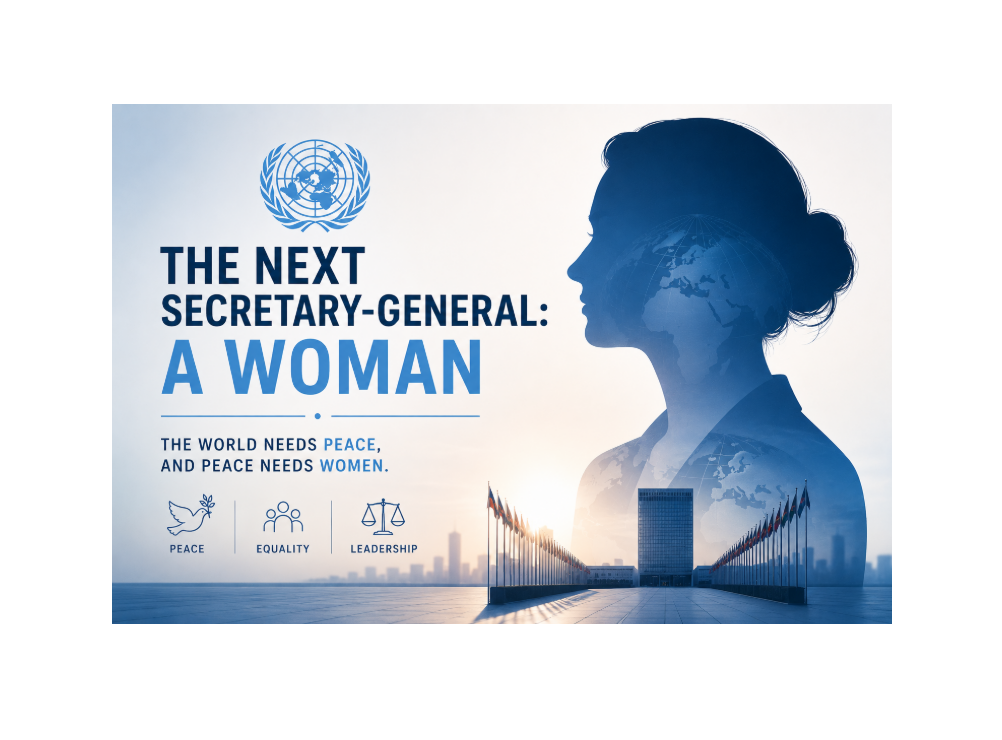
The World Needs Peace, and Peace Needs Women
From Equality in Words to Parity in UN Leadership
An Op-Ed by Dr. Seyed Masoud Noori
Since its founding in 1945—nearly eighty years ago—the United Nations has had nine Secretaries-General, all of them men:
- Trygve Lie (Norway, 1946–1952)
- Dag Hammarskjöld (Sweden, 1953–1961)
- U Thant (Myanmar/Burma, 1961–1971)
- Kurt Waldheim (Austria, 1972–1981)
- Javier Pérez de Cuéllar (Peru, 1982–1991)
- Boutros Boutros-Ghali (Egypt, 1992–1996)
- Kofi Annan (Ghana, 1997–2006)
- Ban Ki-moon (Republic of Korea, 2007–2016)
- António Guterres (Portugal, 2017–present)
Of these nine leaders, seven served two terms, while only two served a single term:
- Trygve Lie (Norway), who resigned early amid escalating Cold War tensions.
- Boutros Boutros-Ghali (Egypt), who was blocked from reappointment despite enjoying broad international support.
The Hidden History of Selection
Until the mid-2010s, the Secretary-General’s selection process unfolded entirely behind closed doors, without a public list of candidates. Although transparency has improved since the 2016 reforms—leading to the official nomination of several highly qualified women, including former heads of government and foreign ministers—none was ultimately chosen.
This historical record makes two realities painfully clear: a glass ceiling still firmly exists at the peak of multilateral diplomacy, and this persistent lack of gender diversity seriously undermines both the UN’s legitimacy and its effectiveness.
Why Gender Balance Matters
Research by UN Women and the Council on Foreign Relations demonstrates that women’s participation in peace processes substantially increases the probability of durable peace. During the COVID-19 pandemic, leaders such as Jacinda Ardern, Angela Merkel, Sanna Marin, and Tsai Ing-wen demonstrated empathy, clarity, and evidence-based governance—qualities that saved lives and rebuilt public trust.
Women’s leadership, characteristically collaborative and accountable, has also bridged deep divides in global health, climate governance, and human rights—domains where the UN’s credibility depends entirely on inclusion and compassion.
A Moment for Change
As António Guterres’s second and final term concludes this year, the world stands at a critical crossroads. With the next Secretary-General set to take office in 2027, the UN must now insist that its next leader be a qualified woman if it truly believes in equality and shared humanity. This must be pursued not as mere symbolism, but as an act of structural justice.
Such a leader should embody:
- Proven multilateral experience;
- A proven capacity for impartial consensus-building;
- An unwavering commitment to the UN Charter and human rights;
- The moral authority required to engage both sovereign governments and civil society.
Appointing a woman would send three powerful messages:
- Credibility: The UN must finally practice the equality it preaches.
- Representation: A woman at the helm would restore public trust amid today’s compounding crises.
- Renewal: Diverse leadership expands the UN’s institutional imagination and operational effectiveness.
Managing Expectations
Crucially, we must avoid imposing unfair expectations. A female Secretary-General cannot be expected to instantly solve the world’s entrenched crises or single-handedly reform the UN’s structural flaws. Setting such impossible standards risks reinforcing the patriarchal myth that male leadership is inherently more viable or effective.
Instead, her appointment should be viewed not as an overnight miracle, but as a long-overdue moral correction—one that realigns the United Nations with its founding ideals of justice, dignity, and inclusion.
The Broader Vision
The next Secretary-General must rebuild shattered multilateralism, bridge growing divides between the Global North and South, and confront the accelerating climate and inequality crises. These challenges demand leadership that listens, mediates, and unites—leadership that is both principled and deeply pragmatic.
History abounds with women who exemplify these exact qualities: Ellen Johnson Sirleaf, Michelle Bachelet, and many others across various regions and traditions. The reservoir of capable female leaders is vast; it is only the political will to act that remains lacking.
A Call to Begin Now
With Guterres’s term ending in late 2026, the time for decisive action is now. Diplomats, civil society organizations, and global citizens must actively advocate, coordinate, and build strategic coalitions to ensure that qualified women are nominated early and visibly.
Systemic change at the United Nations requires sustained advocacy and courage. If we delay, we risk yet another all-male outcome.
Eighty years is enough. The institution that stands as the global vanguard for peace and human dignity deserves a leader who fully embodies both.
The world needs peace, and peace needs women. When that woman takes office, her success will not be measured by solving every global problem, but by breaking the oldest glass ceiling in multilateralism—and ensuring that the ideals of the United Nations finally reflect the full diversity of the humanity it serves.