
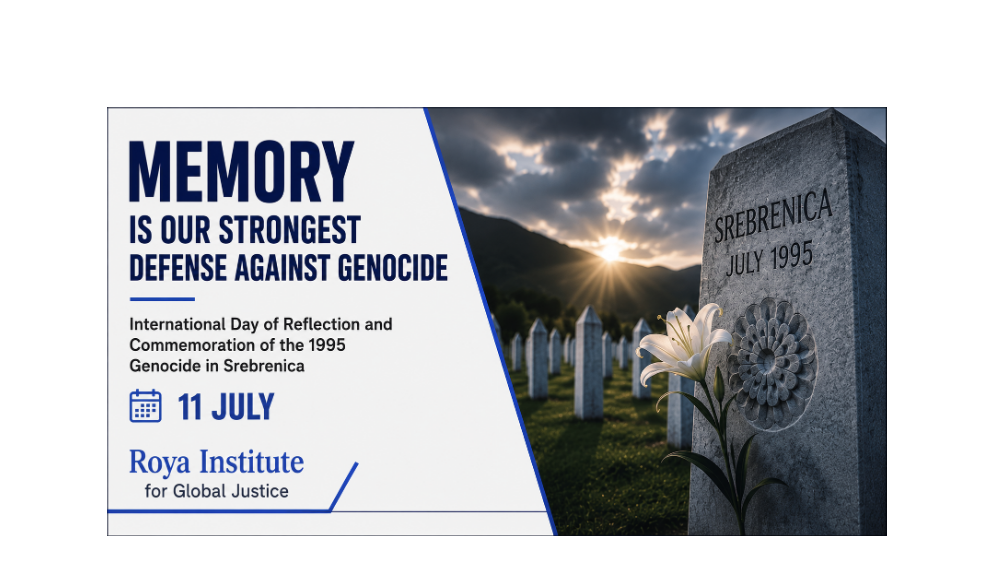
More than three decades after the genocide in Srebrenica, its lessons remain painfully relevant. Remembering this tragedy is not merely an act of honoring the victims; it is a commitment to protecting future generations from hatred, dehumanization, and mass atrocities.
In July 1995, more than 8,000 Bosniak Muslim men and boys were systematically murdered in and around Srebrenica after the town—designated by the United Nations as a “safe area”—fell to Bosnian Serb forces. The massacre has since been recognized by international courts as genocide, making it the gravest atrocity committed in Europe since the Second World War.
Srebrenica reminds us that genocide is never a sudden event. It is the culmination of a gradual process in which prejudice becomes discrimination, discrimination becomes exclusion, exclusion becomes persecution, and persecution ultimately becomes extermination. The warning signs often emerge long before violence begins, yet too frequently they are ignored.
The International Day of Reflection and Commemoration of the 1995 Genocide in Srebrenica, established by the United Nations General Assembly in 2024, calls upon the international community not only to remember the victims but also to strengthen education, promote historical truth, and combat genocide denial and the glorification of war criminals. Memory is not about preserving the past alone; it is about shaping a more responsible future.
For Roya Institute for Global Justice, remembrance is inseparable from justice. Human dignity cannot flourish where historical truth is denied or where victims are forgotten. Sustainable peace requires accountability, the protection of human rights, inclusive institutions, and a culture that values every human life equally, regardless of ethnicity, religion, nationality, or identity.
The legacy of Srebrenica also reminds us of the responsibility shared by governments, international organizations, educators, civil society, and ordinary citizens. Preventing future atrocities requires more than legal instruments. It demands ethical leadership, courageous public institutions, early warning mechanisms, and societies willing to challenge hatred before it becomes violence.
At a time when armed conflicts, forced displacement, identity-based violence, and hate speech continue to threaten communities around the world, the lessons of Srebrenica remain urgently relevant. Commemoration should inspire action: defending human dignity, resisting dehumanization, protecting vulnerable communities, and strengthening the institutions that prevent mass atrocities.
As we observe the International Day of Reflection and Commemoration of the 1995 Genocide in Srebrenica, we honor the memory of those who were lost by reaffirming a simple yet profound principle: every human life possesses equal dignity, and remembering the past is one of our strongest responsibilities toward the future.
Call to Action
Remembering Srebrenica is more than a tribute to history—it is a commitment to the future. Let us strengthen education, confront hatred and denial wherever they appear, support institutions that uphold justice and accountability, and work together to build societies where every person’s dignity is protected and mass atrocities are never repeated.
References
United Nations General Assembly. Resolution A/RES/78/282
https://documents.un.org/doc/undoc/gen/n24/111/50/pdf/n2411150.pdf
United Nations Srebrenica Outreach Programme
https://www.un.org/en/preventgenocide/bosnia
International Court of Justice, Bosnia v. Serbia (2007)
https://www.icj-cij.org/case/91
ICTY Srebrenica Cases
https://www.icty.org/en/cases