
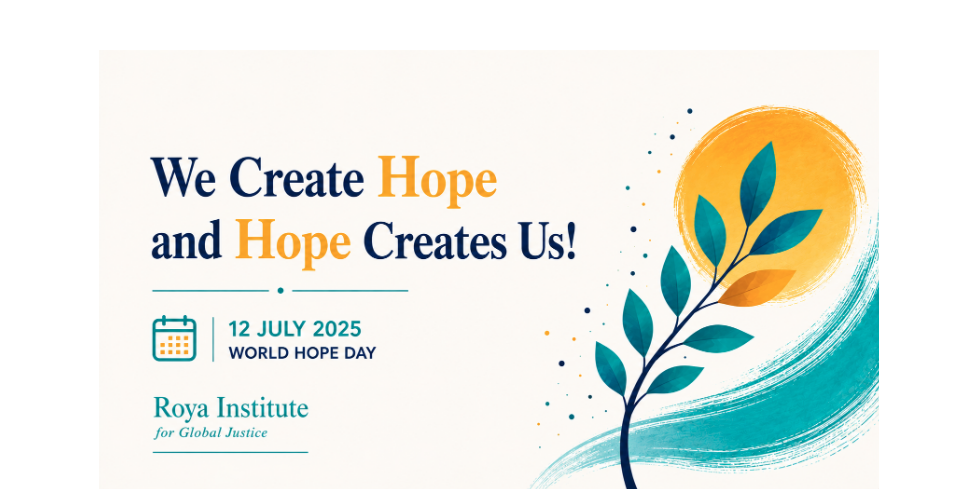
July 12- International Day of Hope
Hope, A Commitment to Persistence
“Hope is not the conviction that something will turn out well, but the certainty that something makes sense, regardless of how it turns out.” — Václav Havel
In a world increasingly defined by the shadows of conflict, forced displacement, systemic inequality, environmental instability, and eroding public trust, speaking of hope can often feel naive or disconnected from reality. However, hope is not a form of denial; it is a conscious, courageous choice—a refusal to surrender to the darkness.
Too often, hope is conflated with mere optimism. While optimism is the expectation that things will improve, hope is a profound, active force. It calls upon us to continue our journey even when the horizon is obscured and the path is arduous. It is the fuel that compels us to believe in the possibility of transformation and to strive toward it, undeterred.
History reveals that the most significant human milestones were once deemed impossible. The abolition of slavery, the expansion of universal education, the architecture of international human rights, the struggle for self-determination, and the relentless pursuit of scientific and social justice were all spearheaded by individuals who refused to yield to the constraints of their era. Their actions were not driven by passive longing, but by a hope that had been crystallized into vision, strategy, and relentless action.
It is for this reason that the United Nations has recognized an International Day of Hope, underscoring its role as a catalyst for solidarity, international cooperation, sustainable development, and lasting peace. This observance serves as a vital reminder that our collective future is not built solely on economic or technological advancements; it is fundamentally tethered to our capacity to sustain hope, especially amidst profound adversity.
True hope, however, is only valuable when it is married to responsibility. Hope that remains a private sentiment or a fragile wish lacks the power to reshape our world. Authentic hope compels us toward education, dialogue, cooperation, the defense of human dignity, and the courageous challenge of injustice. It achieves its full potential only when it is transformed into moral agency.
Our world today requires this brand of hope more than ever. With millions navigating the precarity of war, poverty, climate displacement, and structural inequality, hope is not a luxury—it is an ethical and social imperative. It provides the fortitude for individuals and societies to endure, rebuild, and innovate.
Many philosophical and spiritual traditions characterize hope as an active virtue rather than a passive state of mind. It does not invite us to wait, but to participate. A society that abandons hope inevitably loses its trust, its cohesion, and its drive for progress. Conversely, a society that anchors hope in knowledge, accountability, and justice retains the resilience to emerge from even the deepest crises.
At the Roya Institute for Global Justice, we believe that hope is the cornerstone of justice. No lasting reform can take root without it, and no hope can survive without commitment. For us, hope is manifested through education, rigorous research, constructive discourse, human empowerment, and the cultivation of cross-cultural solidarity. It becomes a transformative force when each individual recognizes their agency in crafting a more equitable future.
Today, the defining question is not, “Is there still hope?” but rather, “What concrete action can I take today to translate hope into a tangible reality?” Future generations will not be defined by our optimism alone; they will be shaped by those who turn hope into responsibility, and responsibility into decisive action.
A Call to Reflection
On this International Day of Hope, let us redefine hope not as a fleeting emotion, but as a moral commitment—a pledge to build a world where every person can live with dignity, security, and promise. Perhaps the greatest expression of hope lies in the decision, even in the most daunting of times, to be part of the solution rather than part of the problem.
References
- Havel, Václav. Disturbing the Peace: A Conversation with Karel Hvížďala. New York: Alfred A. Knopf, 1990.
- United Nations General Assembly. Resolution A/RES/79/270: International Day of Hope.
- United Nations. International Day of Hope. https://www.un.org/en/observances/hope-day
- United Nations. Transforming Our World: The 2030 Agenda for Sustainable Development.