
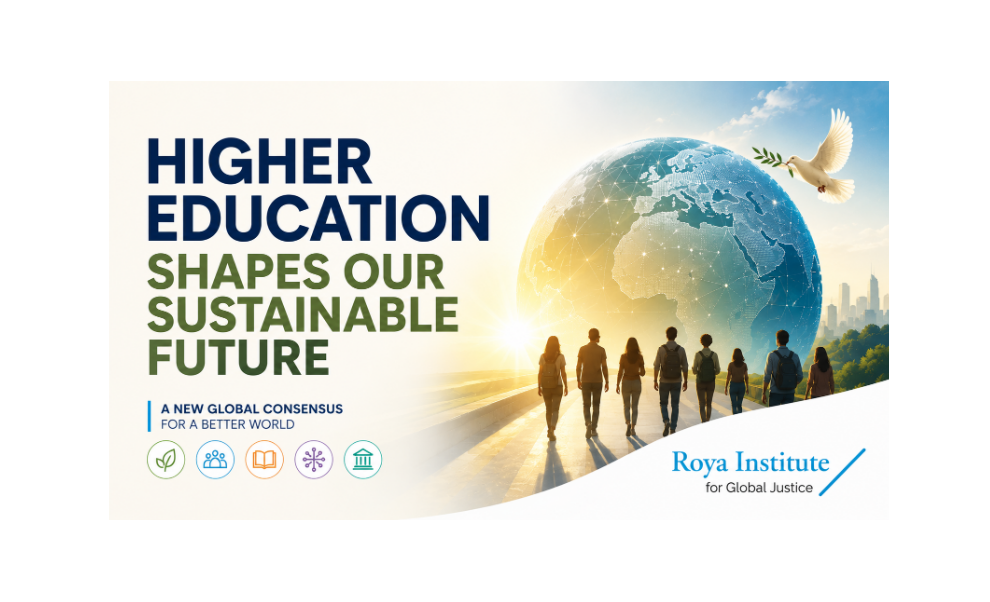
The international community has taken an important step toward redefining the role of higher education in addressing the world’s most pressing challenges.
On July 13, 2026, on the sidelines of the United Nations High-Level Political Forum (HLPF), the Second Global Higher Education Symposium (GHES II) launched Building Sustainable Futures: A Consensus Statement on the Unique Position of Higher Education in the Pursuit of Solutions. Published by the United Nations Academic Impact (UNAI) in collaboration with UNESCO, UNITAR, the International Association of Universities, the International Science Council, SDSN, and other global partners, the document argues that universities should no longer be viewed merely as institutions of teaching and research but as essential partners in shaping a more sustainable, democratic, and resilient world.
The statement comes at a critical moment. As progress toward the Sustainable Development Goals (SDGs) remains uneven and discussions about the post-2030 global development agenda intensify, the document calls for bringing higher education from the margins of international policymaking to its center. It emphasizes that universities possess unique capacities to generate reliable knowledge, foster inclusive dialogue, develop innovative solutions, and bridge the persistent gap between research, public policy, and societal practice.
The Consensus Statement identifies five strategic priorities for higher education worldwide:
- Embedding sustainability across higher education, integrating the SDGs into teaching, research, institutional governance, and community engagement.
- Strengthening democratic values, public trust, and institutional responsibility, including protecting academic freedom, integrity, autonomy, inclusion, and equitable access to knowledge.
- Advancing knowledge pluralism and inclusion, promoting epistemic justice, recognizing diverse knowledge traditions, and supporting historically underrepresented communities.
- Harnessing science, technology, and artificial intelligence for the public good, while ensuring ethical governance, open access to knowledge, and stronger connections between science, policy, and society.
- Reforming governance and funding systems, encouraging collaboration over competition, supporting interdisciplinary research, and aligning higher education with long-term societal needs rather than short-term institutional incentives.
Beyond these priorities, the document recognizes several emerging challenges that will shape the future of higher education, including student and faculty well-being, widening inequalities in access and affordability, the rapid transformation brought about by artificial intelligence, and the need to strengthen universities’ contributions to their surrounding communities.
For institutions committed to advancing human dignity, justice, and sustainable development, the publication carries an important message: universities are not simply places where knowledge is transmitted. They are public institutions capable of strengthening democratic societies, informing evidence-based policymaking, promoting international cooperation, and cultivating the values necessary for peaceful and sustainable futures.
As the world begins to imagine the global agenda beyond 2030, this Consensus Statement offers a timely reminder that higher education should not merely respond to change—it should help lead it.
Source: