
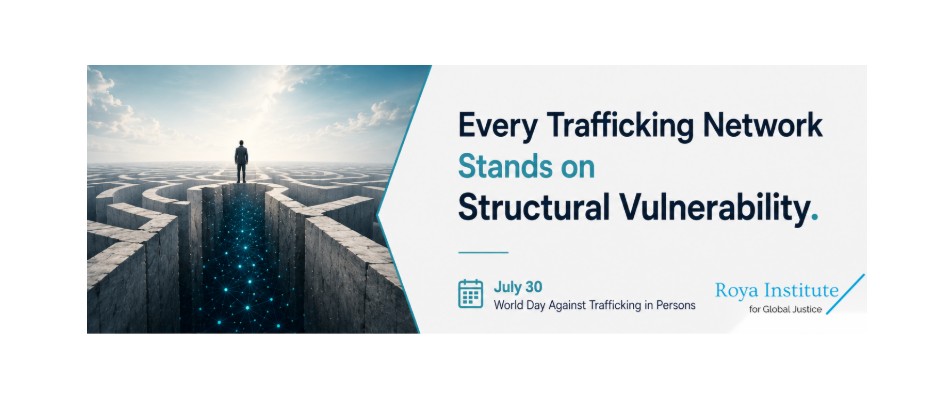
July 30- World Day Against Trafficking in Persons
Every year, the World Day Against Trafficking in Persons reminds us of one of the world’s most organized and profitable forms of exploitation. According to the United Nations, victims from 162 nationalities were identified in 128 countries in 2022. Approximately 74% of traffickers operated as part of organized criminal groups, while nearly 70%of those investigated, prosecuted, or convicted for trafficking offenses were men. African victims accounted for 31% of cross-border trafficking flows. These figures reveal that human trafficking is not a collection of isolated crimes but a deeply entrenched global system.
Yet focusing exclusively on traffickers—even though criminal accountability is indispensable—does not fully explain why human trafficking persists. A more fundamental question remains:
What makes people vulnerable to trafficking in the first place?
In development studies, disaster research, and social justice scholarship, an important distinction has long been made between hazards and vulnerability. An earthquake, for example, is a natural phenomenon. But who dies, who loses their home, and who remains trapped in poverty for years afterward depends largely on social conditions: the quality of housing, the prevalence of poverty, corruption in enforcing building regulations, access to insurance, the effectiveness of emergency response systems, and fairness in reconstruction efforts.
For this reason, disaster studies often observe:
“Natural hazards are natural; disasters are largely socially constructed.”
The same analytical logic applies to human trafficking.
Trafficking networks rarely create vulnerability themselves. Rather, they exploit structural vulnerabilities that already exist—vulnerabilities produced by war, poverty, forced displacement, statelessness, discrimination, corruption, weak educational and social protection systems, gender inequality, and the collapse or failure of public institutions. These are not inherent characteristics of individuals; they are the consequences of political, economic, and social structures that deprive people of security, opportunity, and meaningful choices.
From this perspective, structural vulnerability may be understood as a condition in which individuals become susceptible to exploitation not because of who they are, but because unequal institutions, violent conflict, discriminatory systems, or ineffective public policies place them in positions of heightened risk.
Seen through this lens, the primary capital of trafficking networks is not simply money, weapons, or technology. It is structural vulnerability itself. Traffickers do not primarily prey on people; they capitalize on conditions that leave people with few alternatives. They do not manufacture human beings—they exploit fractures already embedded in economic, political, legal, and social systems.
This perspective also changes how success in combating human trafficking should be measured.
Law enforcement, criminal prosecution, and dismantling organized trafficking networks remain essential. Yet as long as the structures that generate vulnerability remain intact, trafficking networks will continue to find new victims.
A sustainable response therefore requires more than criminal justice. Reducing poverty, expanding educational and economic opportunities, protecting migrants, refugees, and stateless persons, combating corruption, strengthening the rule of law, reducing discrimination, and building resilient public institutions are not merely social policy objectives—they are essential strategies for preventing human trafficking. The more societies reduce structural vulnerabilities, the smaller the operating space for trafficking networks becomes.
The World Day Against Trafficking in Persons is therefore not only an occasion to stand with survivors. It is also an opportunity to examine the systems that produce and reproduce vulnerability.
If structural vulnerabilities are the primary capital of trafficking networks, perhaps the true measure of progress should not be only the number of traffickers arrested, but also the extent to which societies succeed in reducing the vulnerabilities on which trafficking depends.