
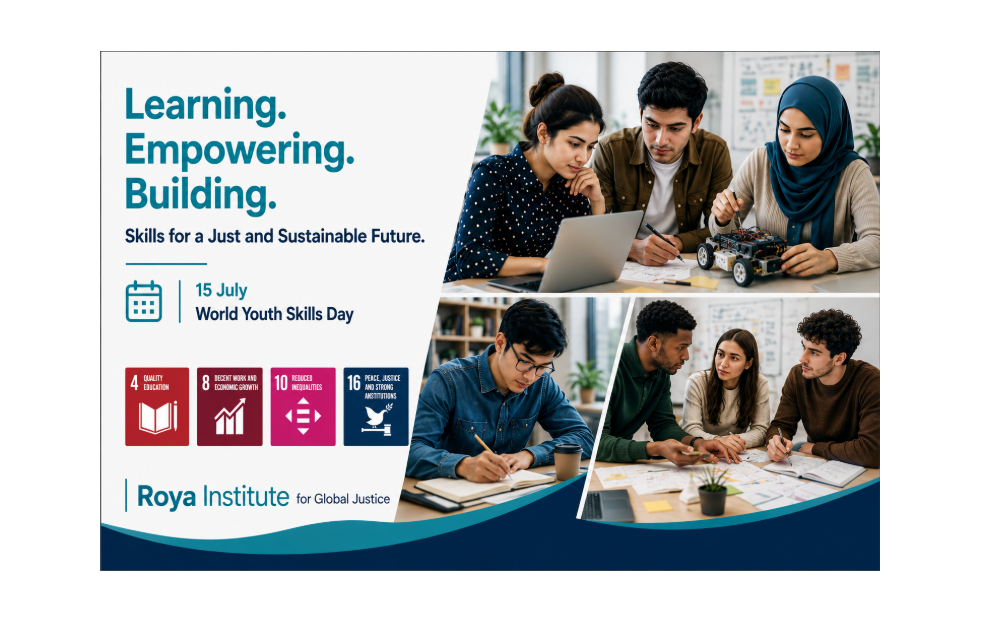
Empowering Youth Through Skills: A Foundation for Social Justice and Sustainable Development
July 15 – World Youth Skills Day
The United Nations General Assembly proclaimed 15 July as World Youth Skills Day in 2014, and the international community has observed it annually since 2015. The Day was established to highlight the critical role of skills development in empowering young people, improving their life opportunities, and advancing sustainable development. It reminds us that quality education and lifelong learning are not only pathways to employment but also essential foundations for reducing poverty, promoting social inclusion, strengthening resilient communities, and realizing human rights.
Young people are among humanity’s greatest assets. Today, more than 1.2 billion people—approximately 16 percent of the world’s population—are between the ages of 15 and 24, and nearly 90 percent of them live in low- and middle-income countries, particularly across the Global South. Their knowledge, creativity, innovation, and energy will play a decisive role in shaping the future of their societies and achieving more just and sustainable development.
Yet millions of young people continue to face significant barriers to acquiring quality education and relevant skills. Poverty, armed conflict, forced displacement, discrimination, unequal access to education, and the digital divide continue to prevent many from reaching their full potential. For these young women and men, the challenge extends well beyond securing employment; it is about having an equal opportunity to participate fully in society, exercise their rights, and help shape the future of their communities.
Technical and vocational skills remain indispensable, but they are no longer sufficient on their own. Today’s youth also need life skills—including critical thinking, creative problem-solving, effective communication, teamwork, peaceful conflict resolution, digital and media literacy, the ability to distinguish reliable information from misinformation, awareness of human rights and civic responsibilities, and meaningful participation in public life. These competencies form the foundation of societies with informed citizens, stronger democratic institutions, and broader civic engagement.
This understanding is firmly rooted in the international human rights framework. Article 26 of the Universal Declaration of Human Rights affirms that education should promote the full development of the human personality and strengthen respect for human rights and fundamental freedoms. Skills development should therefore empower individuals not only to earn a livelihood, but also to defend their rights and the rights of others, respect diversity, engage constructively in public life, and contribute to justice, peace, and social cohesion.
World Youth Skills Day also underscores the close relationship between youth empowerment and the Sustainable Development Goals (SDGs). Expanding equitable access to quality education and skills development directly advances SDG 4 (Quality Education), SDG 8 (Decent Work and Economic Growth), SDG 10 (Reduced Inequalities), and SDG 16 (Peace, Justice and Strong Institutions). Investing in young people’s education and capacities is not merely an economic strategy; it is a foundational investment in building inclusive, just, peaceful, and sustainable societies.
At the Roya Institute for Global Justice, we believe that empowering young people through education, skills development, human rights literacy, and meaningful participation is one of the most effective ways to advance social justice and sustainable development. Every young person deserves the opportunity to develop their talents, realize their full potential, and contribute to building societies where freedom, equality, justice, and human rights are respected and protected for all.
Primary Sources
- United Nations. World Youth Skills Day.
https://www.un.org/en/observances/world-youth-skills-day - United Nations General Assembly. Resolution 69/145: World Youth Skills Day (18 December 2014).
https://documents.un.org/doc/undoc/gen/n14/670/10/pdf/n1467010.pdf - Universal Declaration of Human Rights. Article 26.
https://www.un.org/en/about-us/universal-declaration-of-human-rights
Further Reading
- UNESCO-UNEVOC. World Youth Skills Day.
https://unevoc.unesco.org - International Labour Organization (ILO). Skills and Lifelong Learning.
https://www.ilo.org