
⏰2/5
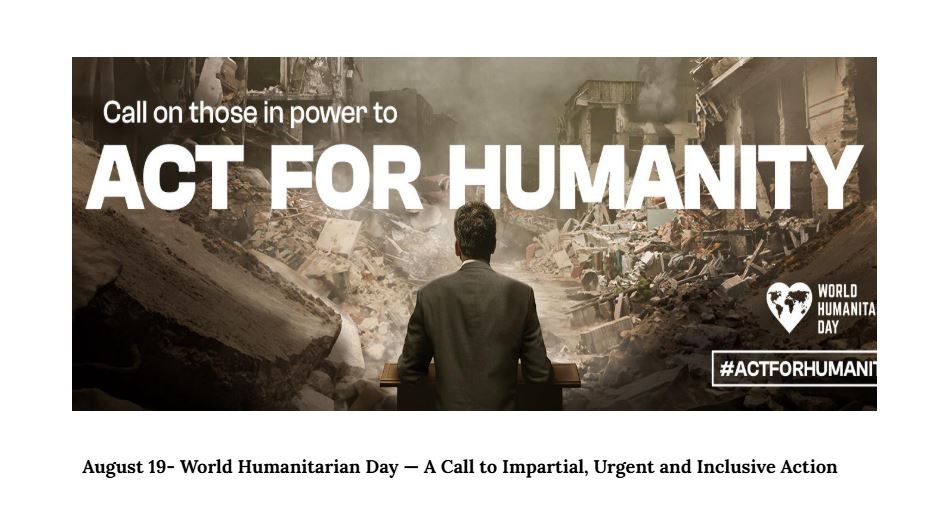
On August 19, the world marks World Humanitarian Day, an international observance established by the United Nations General Assembly to honor humanitarian workers and underscore the critical importance of global solidarity and international cooperation in crisis response. This date commemorates the tragic bombing of the UN headquarters in Baghdad in 2003, which claimed the lives of 22 aid workers, including Sérgio Vieira de Mello.
This Year’s Theme: Strengthening Solidarity, Empowering Communities
The official theme for 2025 emphasizes “Strengthening Global Solidarity and Empowering Local Communities.” The message is clear: the international community must come together in support of those affected by crises—and do so in partnership with local actors, recognizing and reinforcing their agency.
Upholding Humanitarian Principles
Humanitarian action must remain guided solely by the needs of people in distress—without political bias or double standards. Neutral, impartial, and independent humanitarianism protects the dignity of all, regardless of geography or politics.
Crises Demanding Immediate, Unconditional Response
We reaffirm our urgent call for humanitarian attention and action in these pressing contexts:
• Gaza — Facing a catastrophic humanitarian emergency, where civilians are deprived of essential services and aid workers operate under extreme risk.
• Pakistan (Floods) — Communities devastated by floods continue to need sustained relief and rebuilding, far beyond initial rescue efforts.
• Sudan — Ongoing conflict has left countless war-affected people without protection, shelter, or access to basic needs.
• Afghanistan — Decades of humanitarian crises—ranging from conflict to economic collapse and natural disasters—have left millions in immediate need of aid.
• Yemen, Ukraine, Somalia, Myanmar — All facing severe humanitarian disasters shaped by conflict, displacement, or chronic underfunding.
These regions illustrate the universal imperative of humanitarian law and the urgent need for equitable, principled responses everywhere.
Facts & Figures
• In 2025, 305.1 million people in 72 countries will need humanitarian assistance, requiring $47.4 billion in funding.
• Around 400 million children—1 in 5 globally—live in or are fleeing conflict zones.
• Four out of five civilian deaths in conflicts occurred in countries with humanitarian appeals; more than 58,700 civilians were killed in 2024.
• In 2023, 363 climate-related disasters displaced 26.4 million people, disrupting homes, food systems, and economies.
• Despite its cost-effectiveness, cash and voucher assistance (CVA) stagnated at 23% of global humanitarian aid in 2023.
• In Sudan, 11 million people are internally displaced—30% of the population.
• In 2024, the UN verified over 36,000 civilian deaths in 14 armed conflicts, many caused by explosive weapons in urban areas.
• By mid-2024, 122.6 million people were forcibly displaced worldwide, including 90% of Gaza’s population (1.9 million people).
• Over 360 humanitarian workers were killed in 2024—200 in Gaza alone—making it the deadliest year on record for aid workers.
• More than 52 million children were out of school due to conflict in 2024; in Gaza alone, 12,035 students and 492 teachers were killed, while 88% of schools were damaged.
• Over 280 million people faced high levels of food insecurity in 59 conflict-affected countries; in Sudan, 25 million people were affected and more than 755,000 faced famine-level conditions.
⸻
Sources
• https://www.un.org/en/observances/humanitarian-day
• United Nations OCHA, Global Humanitarian Overview 2025
• United Nations Security Council, Report S/2025/271