
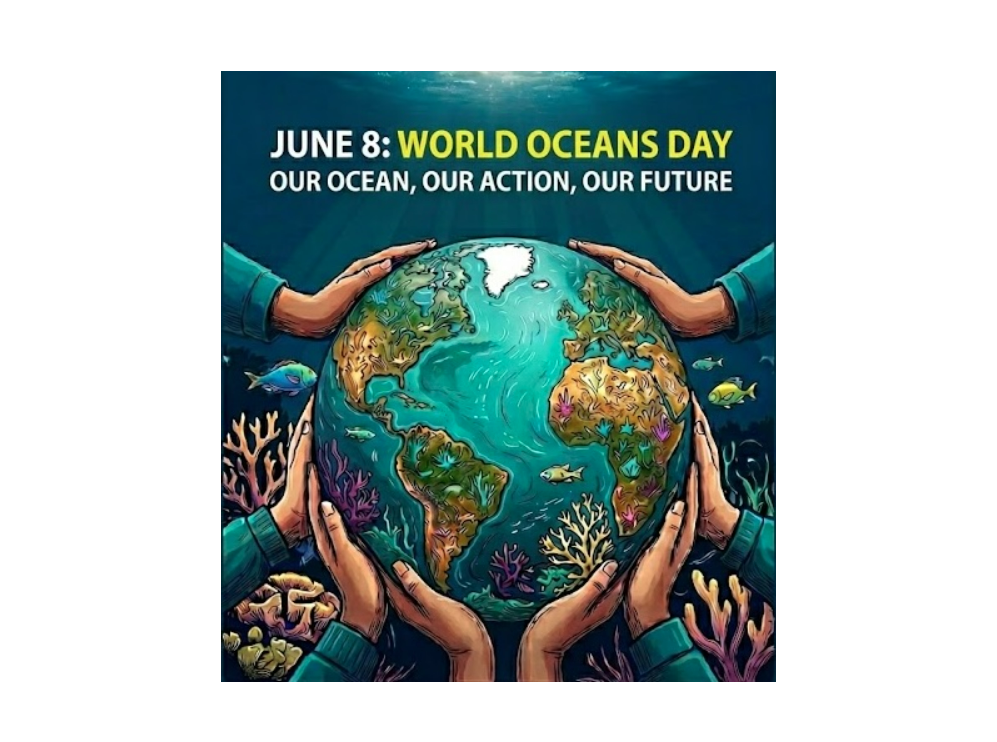
Oceans, Human Dignity, and Our Shared Responsibility
Every year on June 8, the international community observes World Oceans Day to remind humanity that oceans are not distant bodies of water separated from human life. They are among the foundations of life itself.
The ocean covers more than 70 percent of the Earth’s surface and plays a critical role in regulating the global climate. It produces at least half of the oxygen we breathe, absorbs approximately 30 percent of human-generated carbon dioxide emissions, and helps reduce some of the impacts of global warming. According to the United Nations, millions of people depend directly on ocean-based livelihoods, and ocean-related industries are expected to employ around 40 million people worldwide by 2030.
Oceans are also home to an extraordinary share of the planet’s biodiversity. From microscopic organisms to the largest mammals on Earth, marine ecosystems sustain life in ways that are often invisible to us. Healthy oceans support fisheries, food systems, transportation, tourism, scientific innovation, and the economic well-being of countless communities.
Yet today, marine ecosystems face growing threats from pollution, overfishing, habitat destruction, climate change, rising sea levels, and the uncontrolled disposal of plastics and industrial waste.
Environmental destruction is not only an ecological crisis. It is also a human rights concern.
When oceans are polluted or depleted, communities lose access to food security, clean water, healthy environments, and sustainable livelihoods. Coastal populations, indigenous communities, small island states, fishing families, and future generations often bear the greatest burdens despite contributing the least to environmental degradation.
Protecting the oceans therefore requires more than technical solutions. It demands a dignity-centered approach that recognizes the interconnected relationship between environmental sustainability, social justice, and human rights.
Public awareness plays a vital role in this effort. Environmental protection cannot succeed through governmental action alone. Educational institutions, civil society organizations, researchers, faith communities, youth movements, artists, journalists, and local communities all have a role to play in promoting environmental responsibility and informed public engagement.
Meaningful action can begin with simple steps:
- Reducing single-use plastics
- Supporting sustainable consumption
- Protecting marine biodiversity
- Promoting environmental education
- Encouraging responsible public policies
- Supporting scientific research
- Holding institutions accountable for environmental harm
At Roya Institute, we believe environmental justice is inseparable from human dignity, peace, and social responsibility. Defending the oceans means defending life itself—both for present and future generations.
World Oceans Day is not only an occasion for reflection. It is also a call to education, advocacy, and collective action.