
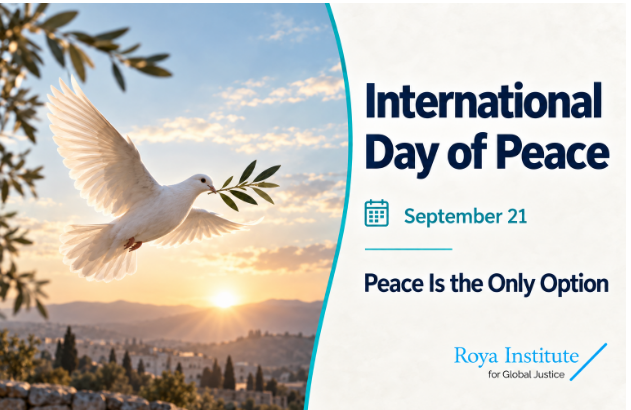
The International Day of Peace offers an opportunity to reflect on one of humanity’s most fundamental aspirations—an aspiration that may seem increasingly difficult to achieve, yet has never been more urgently needed.
Established by the United Nations (UN) General Assembly in 1981, the International Day of Peace was designated in 2001 as an annual day of global ceasefire and non-violence, observed on September 21. This year’s theme, “Invest in Peace: For Everyone, Everywhere, Every Day,”reminds us that peace is not merely a matter for diplomatic negotiations. It is a shared responsibility that must become a lived reality in communities and families around the world.
A World Under the Shadow of War and Escalating Conflict
Ongoing wars and the possibility of further military confrontations in different parts of the world pose serious risks to international peace and security. The war in Ukraine, the suffering of civilians in Gaza, the humanitarian crisis in Sudan, and renewed fighting in Yemen are among the conflicts that have profoundly disrupted millions of lives.
In the Middle East, insecurity along strategic maritime routes has deepened these concerns. On September 16, 2026, the International Maritime Organization warned about attacks on merchant vessels in and around the Strait of Hormuz and the deaths of seafarers. Meanwhile, a briefing to the UN Security Council reported increasing volatility around the Bab el-Mandeb Strait. Insecurity in these two strategic waterways can affect trade, energy supplies, and livelihoods far beyond the immediate areas of conflict.
In East Asia, tensions between the United States and China over Taiwan—including disagreements surrounding US arms sales to the island—remain a matter of international concern. In Europe, the entry of Russian drones into Polish airspace on September 10, 2025, and the defensive response by Poland and its NATO allies offered another warning about the danger of the war in Ukraine extending beyond its borders.
What these crises share is that their consequences do not stop at political or geographical boundaries. War destroys homes, schools, and hospitals; separates families; disrupts access to food, medicine, education, and employment; and imposes profound economic and psychological costs on present and future generations.
Children, women, older persons, persons with disabilities, refugees, displaced people, and low-income communities often face particularly severe consequences. For a family that has lost the safety of its home, access to daily food, or the possibility of educating its children, peace is not an abstract ideal. It is an immediate necessity for life.
Peace Is Not One Option Among Many, but a Human Necessity
Under these circumstances, global peace and security may seem difficult and distant goals. Yet the difficulty of achieving peace cannot justify abandoning it.
Peace is not simply one option among many; it is the only sustainable path toward protecting human life, dignity, and our shared future.
No political, territorial, or security dispute should make civilian suffering appear normal or acceptable. Despite their disagreements, states and other actors remain responsible for protecting human life, respecting international law, and seeking peaceful means of resolving conflicts.
Prolonged conflicts may generate political advantage for those who benefit from escalating tensions or economic profits for businesses that supply weapons. For people who lose loved ones, homes, health, and opportunities, however, war brings suffering and insecurity. Human lives must not become the price of power struggles or the expansion of arms markets.
Ending War Is the First Step; Genuine Peace Goes Further
Ending the killing, violence, and destruction associated with war is the first essential step toward peace—but genuine peace cannot be reduced to the absence of armed conflict.
A ceasefire can save lives and create space for dialogue. Yet a society in which discrimination, extreme poverty, repression, injustice, incitement to hatred, and structural exclusion persist remains far from sustainable peace.
Genuine peace means that every person can enjoy the right to life, security, and human dignity without discrimination. It means equitable access to food, clean water, housing, education, healthcare, and opportunities for a decent life. It requires respect for human rights, the rule of law, and access to justice for victims of violence and injustice.
It also means meaningful participation in decisions affecting people’s lives, especially for women, young people, and marginalized communities. It requires respect for religious, cultural, and ethnic differences, together with a commitment to dialogue rather than violence as a means of resolving disputes.
Above all, genuine peace means creating conditions in which children can grow up without fear and no family is forced to choose between safety, freedom, and a livelihood.
Stopping war is an urgent necessity for saving lives; building lasting peace also requires addressing the conditions that repeatedly give rise to violence and conflict.
Roya’s Call for Collective Action for Peace
On the International Day of Peace, the Roya Institute for Global Justice invites civil society organizations, human rights and humanitarian institutions, religious leaders, academics, educators, artists, media professionals, and all concerned citizens to join efforts to end wars and prevent further escalation—while respecting one another’s independence and diversity of views.
Such cooperation can begin with demanding the protection of civilians, supporting credible ceasefire and negotiation efforts, defending unhindered humanitarian access, countering incitement to hatred, and presenting the human realities of war.
The media can go beyond reporting the positions of parties to a conflict and amplify the voices of affected families. Religious leaders can place the ethical and social resources of their communities in the service of reconciliation and coexistence. Civil society organizations can transform the demand for peace into sustained action across borders.
This year’s UN theme, “Invest in Peace: For Everyone, Everywhere, Every Day,” will acquire its fullest meaning when peace becomes more than an aspiration or an annual slogan—when it becomes a priority in public policy, the allocation of resources, and our everyday conduct.
Peace must begin with an end to killing, be strengthened through justice and respect for human dignity, and be sustained through collective participation.
Peace belongs to every human being. It must never be a privilege reserved for those fortunate enough to live far from war.
References
1. United Nations, International Day of Peace 2026: Invest in Peace—For Everyone, Everywhere, Every Day.
2. United Nations, The History of the International Day of Peace.
3. United Nations Secretary-General, Message for the International Day of Peace 2026.
4. International Maritime Organization, Stop Attacking Merchant Ships and Seafarers, September 16, 2026.
5. United Nations, Briefing to the Security Council on Developments in Yemen, September 15, 2026.
6. Reuters, Defence Firm Anduril Says US Delay on Taiwan Arms Sales Is Affecting Its Business, September 19, 2026.
7. NATO, Statement on the Violation of Polish Airspace by Russian Drones