
From Environmental Destruction to Ecocide: War and Our Responsibility to Future Generations
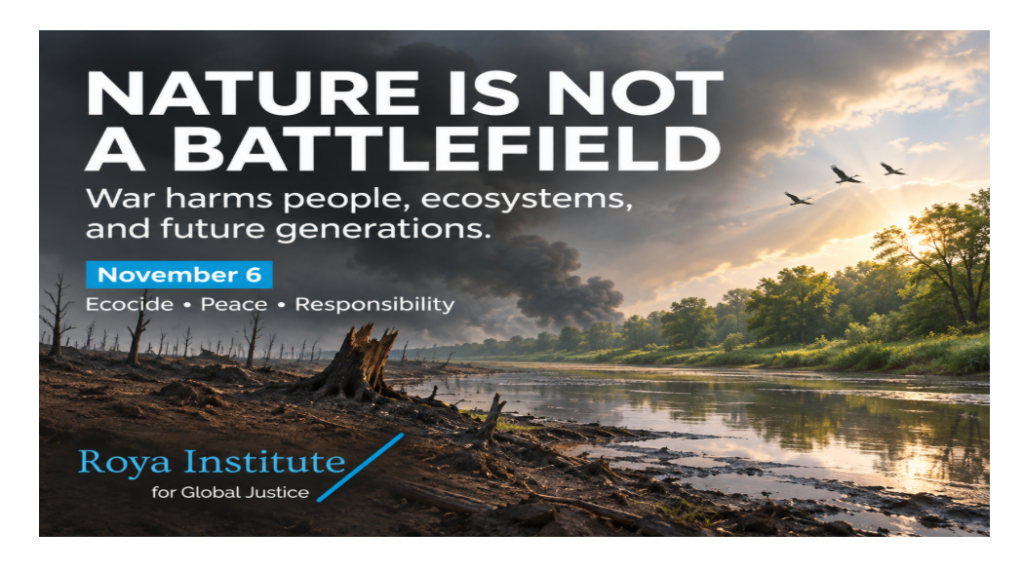
On November 5, 2001, the United Nations General Assembly adopted Resolution A/RES/56/4, declaring November 6 of each year the International Day for Preventing the Exploitation of the Environment in War and Armed Conflict. The resolution recognized that environmental damage caused during armed conflict can impair ecosystems and natural resources long after the fighting ends, often extending beyond national borders and affecting future generations.
When war begins, we count the dead and wounded.
We see children who lose their parents, women and men who lose their spouses, families forced from their homes, cities destroyed, livelihoods lost, and cultural heritage reduced to rubble.
But war can have another victim—one that cannot speak, flee, or seek refuge: the environment.
Water sources can be polluted. Crops can be burned. Forests can be destroyed. Soil can be contaminated, wildlife killed, and animal habitats devastated. Oil, chemicals, sewage, military debris, mines, and unexploded ordnance may continue to threaten communities years after the fighting has ended.
The United Nations describes the environment as an often-unpublicized victim of war, noting that wells have been polluted, crops burned, forests cut down, soils poisoned, and animals killed in armed conflicts.
These realities raise a difficult legal and moral question: When environmental destruction becomes exceptionally severe, widespread, or long-lasting, should it be treated not merely as environmental damage, but as an international crime?
Increasingly, that question is being discussed through one powerful concept: Ecocide.
From Genocide to Ecocide: Similar Words, Different Crimes
The term genocide was coined by Polish lawyer Raphael Lemkin in 1944 and later became firmly established in international criminal law. According to the United Nations definition of genocide, the crime involves specified acts committed with the intent to destroy, in whole or in part, a national, ethnic, racial, or religious group. It was codified as an independent international crime in the 1948 Genocide Convention.
Ecocide is different. The two concepts should not be legally confused. Genocide protects human groups against intentional destruction. Ecocide seeks to address the gravest forms of destruction of the natural world on which human beings, other species, and entire ecosystems depend.
Yet the comparison between the two concepts raises an important question.
International criminal law recognizes that some forms of destruction are so grave that they concern not only individual victims or individual states, but the international community as a whole.
Supporters of criminalizing ecocide ask whether catastrophic environmental destruction should also cross that threshold.
What Does Ecocide Mean?
In 2021, an Independent Expert Panel convened by the Stop Ecocide Foundation proposed a legal definition of ecocide as unlawful or wanton acts committed with knowledge that there is a substantial likelihood of severe and either widespread or long-term damage to the environment.
This definition is significant for two reasons.
First, it sets a high threshold. Not every environmental violation or instance of pollution would constitute ecocide.
Second, the proposed crime is not limited to wartime. Catastrophic destruction of forests, oceans, water systems, soil, biodiversity, or major ecosystems could potentially fall within the concept whether it occurs during armed conflict or in peacetime, provided that the required legal elements are satisfied.
The Movement to Make Ecocide an International Crime
The idea has moved beyond academic discussion.
In 2024, Vanuatu formally submitted a proposal to amend the Rome Statute by adding the crime of ecocide to Article 5 and creating a new Article 8 ter defining the offence. The proposal drew substantially on the definition developed by the Independent Expert Panel.
The proposal continued to be discussed in 2025. Vanuatu updated the International Criminal Court’s Working Group on Amendments on its proposal for an independent crime of ecocide, while indicating that it would continue consultations rather than seek formal adoption at that session.
As of November 2026, however, ecocide has not become a fifth core crime under the Rome Statute. The Rome Statute of the International Criminal Court continues to establish jurisdiction over genocide, crimes against humanity, war crimes, and the crime of aggression.
That distinction is important.
Ecocide is not yet an independent crime within the jurisdiction of the International Criminal Court.
But the legal movement is real and growing.
The European Union’s 2024 Environmental Crime Directive requires more severe treatment of certain environmental offences that produce catastrophic consequences. The Directive expressly states that such qualified offences can encompass conduct comparable to “ecocide,” a concept already covered by the law of some Member States and under discussion in international forums.
France has gone further at the national level. Since 2021, Article L231-3 of the French Environmental Code expressly uses the term écocide for certain intentional environmental offences involving serious and lasting harm.
The debate has therefore moved from advocacy and academic discussion into national legislation, regional law, and formal discussions surrounding the Rome Statute.
Environmental Destruction Is Already Relevant to International Criminal Law
The absence of an independent international crime of ecocide does not mean that environmental destruction is legally irrelevant today.
International humanitarian law already protects the natural environment during armed conflict. The Rome Statute also recognizes as a war crime, in specified circumstances, intentionally launching an attack with knowledge that it will cause widespread, long-term, and severe damage to the natural environment that would be clearly excessive in relation to the anticipated military advantage.
In December 2025, the Office of the Prosecutor of the International Criminal Court launched its Policy on Addressing Environmental Damage Through the Rome Statute.
The Office explains that existing Rome Statute crimes—genocide, crimes against humanity, war crimes, and aggression—may, in certain circumstances, be committed by means of environmental damage or result in environmental damage. At the same time, the ICC expressly distinguishes this approach from proposals to create an independent crime of ecocide.
The existing system therefore asks: Can severe environmental destruction amount to, contribute to, or form part of crimes already recognized under international law?
The ecocide movement asks an additional question: Should the gravest forms of environmental destruction themselves constitute an international crime?
War Does Not Kill Only People
This debate becomes especially urgent in armed conflict.
A military operation may kill people today and destroy the foundations of life tomorrow.
A polluted river can deprive entire communities of safe water.
Contaminated agricultural land can undermine food security for years.
Destroyed forests can eliminate both livelihoods and wildlife habitats.
Damage to oil facilities, factories, sewage systems, dams, or chemical installations can release pollutants far beyond the immediate battlefield.
Mines and unexploded weapons may remain in the earth long after a peace agreement is signed.
The United Nations has documented how armed conflict can contaminate fertile land and water resources, damage forests and ecosystems, and leave landscapes polluted by mines, unexploded ordnance, fires, shelling, and other forms of destruction.
The consequences of environmental destruction do not necessarily respect ceasefires, political borders, or generations.
A child may survive a war and still spend decades living with contaminated water, damaged soil, destroyed agricultural systems, or a degraded ecosystem.
Environmental protection is therefore inseparable from human rights.
A poisoned river is also a human-rights issue.
Destroyed farmland is also a food-security issue.
A devastated forest is also a livelihood issue.
The destruction of biodiversity is also an issue of intergenerational justice.
Responsibility Must Extend Beyond the Battlefield
Those who unlawfully initiate or conduct wars cannot regard environmental destruction as merely a secondary consequence of armed conflict.
Under international law, legal responsibility depends on the circumstances of each case, the applicable rules, and the required elements of responsibility. It should never be assumed without evidence.
But ethical responsibility is broader.
Political leaders, military commanders, states, corporations, arms manufacturers and suppliers, and other actors whose decisions help make warfare possible should confront the foreseeable human and environmental consequences of those decisions.
Weapons do not only kill soldiers and civilians.
They may burn forests.
They may contaminate soil.
They may pollute rivers and seas.
They may destroy habitats and biodiversity.
And their consequences may be inherited by children who had no voice in the decision to go to war.
Where the requirements of international or domestic criminal law are satisfied, legal accountability must follow. Where they are not, the moral responsibility to consider the consequences for civilians, ecosystems, and future generations remains.
The question is therefore not only: Who caused the immediate deaths?
We must also ask: Who contributed to destruction whose consequences will remain long after the war itself has been forgotten?
Peacebuilders Protect the Environment Too
The environmental dimension of war also changes how we should understand peacebuilding.
Peacekeepers, mediators, diplomats, human-rights defenders, anti-war advocates, religious leaders, civil-society organizations, and others who work to prevent or end armed conflict do more than save human lives.
They also protect homes, livelihoods, cultural heritage, forests, rivers, agricultural lands, wildlife, and ecosystems.
The United Nations emphasizes that environmental action should be integrated into conflict prevention, peacekeeping, and peacebuilding because durable peace cannot exist if the natural resources that sustain livelihoods and ecosystems are destroyed.
Every war prevented can mean forests that are not burned.
Every ceasefire can mean fewer toxic substances entering soil and water.
Every conflict resolved peacefully can mean fewer mines and unexploded weapons left beneath the ground.
Every successful peace initiative can protect people living today and people who have not yet been born.
Those who work for peace are also protecting the environment.
Ecocide and the Rights of Future Generations
The concept of ecocide asks law to look beyond immediate victims and immediate time.
Future generations cannot appear before governments today to defend the forests they will need.
They cannot protest contamination of the water they will drink.
They cannot demand protection for species that may disappear before they are born.
They cannot recover ecosystems that have passed an irreversible point of destruction.
We therefore carry responsibilities toward people we will never meet.
Genocide and ecocide are legally different concepts with different elements and histories. They should not be equated.
But both confront us with a profound question about the limits of permissible destruction.
The development of international criminal law after the atrocities of the twentieth century demonstrated that humanity can decide that certain conduct is too grave to be treated as an ordinary matter of domestic concern.
The emerging international debate over ecocide asks whether the most catastrophic destruction of the natural foundations of life deserves a similar international response.
On this International Day for Preventing the Exploitation of the Environment in War and Armed Conflict, the Roya Institute for Global Justice calls for stronger protection of the natural environment during armed conflict; meaningful accountability for unlawful environmental destruction; responsible conduct by states, corporations, and actors involved in the production and transfer of weapons; continued serious international discussion about criminalizing ecocide; and greater recognition of peacebuilders as protectors not only of human life, but also of the environment and future generations.
War does not end on the battlefield.
Its victims may include people, families, cultures, rivers, forests, animals, ecosystems—and generations not yet born.
The growing debate over ecocide therefore leaves us with one of the most important questions of our time:
When the destruction of nature becomes so severe that it threatens communities, ecosystems, and generations to come, should international law recognize that destruction as a crime of concern to humanity as a whole?