Democracy is built by people. Yet the will of the people becomes more effective when expressed through organized social institutions capable of influencing political power.
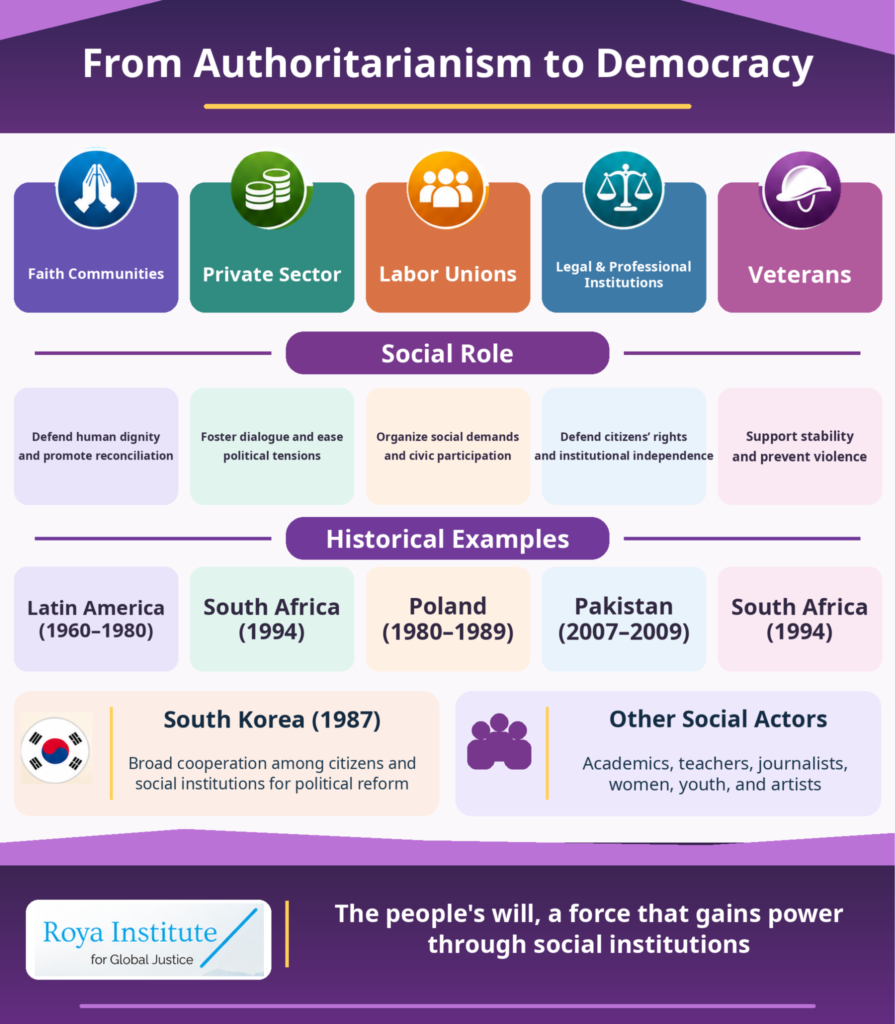
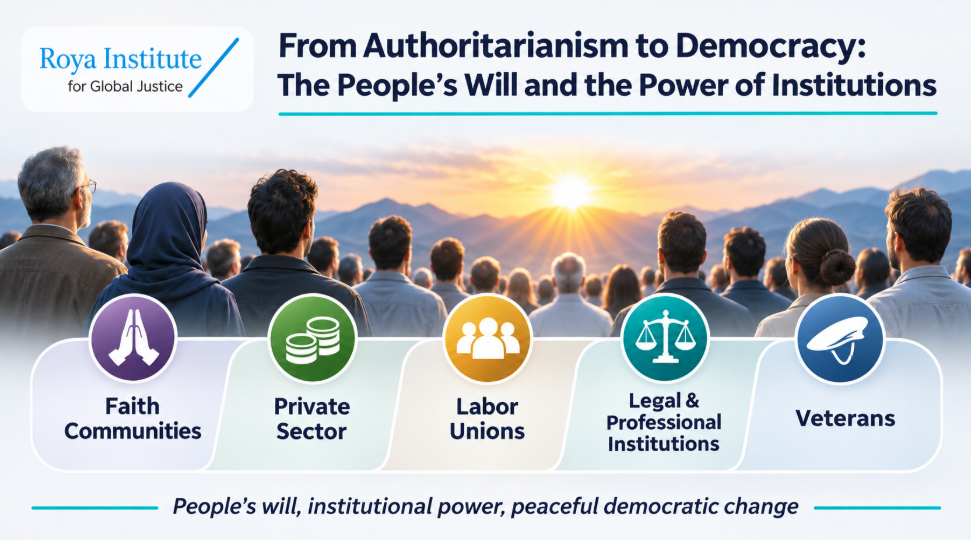
The Pillars of Support framework, developed by the Horizons Project and reflected in its Common Courage initiative, highlights five particularly influential social sectors: faith communities, business communities, labor unions, professional associations, and veterans’ groups.
These institutions are not separate from the people. They are among the most powerful channels through which citizens can organize, express their demands, and influence political decisions.
They can help sustain authoritarian rule, but they can also redirect their influence toward freedom, accountability, and peaceful democratic change.
1. Faith Communities and Religious Institutions
Religious leaders and institutions can draw upon their moral authority, public trust, and community networks to defend human dignity, challenge repression, and encourage nonviolent action.
Latin America offers remarkable examples. Liberation theology emphasized the moral responsibility to stand with the poor and oppressed. In El Salvador, Archbishop Óscar Romero courageously denounced political repression and violence before his assassination in 1980. In Chile, under General Pinochet’s military dictatorship, Catholic institutions, particularly the Vicariate of Solidarity, defended victims of human rights violations and documented abuses.
These experiences demonstrate how religious institutions can become courageous defenders of human rights rather than sources of legitimacy for authoritarian power.
Their contribution becomes especially meaningful when they defend freedom of religion or belief for everyone, including religious minorities and nonbelievers.
2. Business Communities
Businesses and economic institutions influence employment, investment, financial resources, and relationships with political authorities.
South Africa’s transition from apartheid provides an important example. The Consultative Business Movement helped facilitate dialogue among political opponents, business leaders, labor representatives, and other social actors.
Its participation in peace initiatives and negotiations contributed to the broader process that led to South Africa’s first democratic national elections in 1994.
This experience demonstrates how economic actors can serve as bridges between conflicting groups and help create space for negotiated political solutions.
3. Labor Unions
Independent labor unions can transform widespread social and economic grievances into organized, nonviolent civic participation.
Poland’s Solidarity movement offers a historic example. Founded in 1980 as an independent trade union, Solidarity developed into a broad social movement challenging communist authoritarian rule.
Despite repression and martial law, the movement maintained a predominantly nonviolent approach to resistance and organization. Its participation in the 1989 Round Table negotiations helped open the way for elections and democratic political change.
The Polish experience demonstrates how organized workers can combine social mobilization, peaceful resistance, and negotiation to influence the future of an entire country.
4. Legal and Professional Institutions
Lawyers, judges, bar associations, and other professional organizations can defend fundamental rights, challenge arbitrary government actions, and protect institutional independence.
Pakistan’s Lawyers’ Movement (2007–2009) provides a significant example. After General Pervez Musharraf suspended the Chief Justice, lawyers organized widespread protests demanding judicial independence and respect for constitutional principles.
Their mobilization contributed to a broader civic movement and ultimately to the restoration of dismissed judges.
Such institutions become particularly important during political transitions, when the demand for accountability must be protected from turning into revenge, collective punishment, or arbitrary prosecution.
5. Veterans and Former Military Personnel
Veterans and former military personnel can use their experience, public standing, and knowledge of security institutions to promote civilian protection, constitutional principles, and peaceful political change.
South Africa provides a complex but instructive example. In 1994, retired General Constand Viljoen, who had been associated with right-wing opposition to the democratic transition, ultimately entered negotiations and participated in the elections rather than continuing on a path toward armed confrontation.
While this decision does not erase the serious controversies surrounding his earlier political activities, it illustrates how a shift toward constitutional political participation can help reduce the risk of violence.
The broader lesson is that democratic transitions can benefit when influential figures connected to existing power structures redirect their influence toward peaceful political processes.
The People’s Will: Turning Civic Participation into Institutional Power
The five pillars are powerful expressions of society’s collective capacity. Their strength comes from the people who work within them, participate in their activities, and hold them accountable.
Other social actors also play essential and sometimes leading roles:
- University professors, researchers, and students contribute through academic freedom, independent knowledge, critical thinking, and intellectual leadership.
- Schoolteachers and school students help cultivate civic awareness, democratic values, and responsible participation, with special attention to children’s safety and rights.
- Journalists and independent media investigate abuses, expose corruption, challenge disinformation, and enable informed public debate.
- Women and women’s organizations provide leadership, organize communities, and ensure that democratic change reflects the experiences and rights of women.
- Youth movements, artists, healthcare professionals, farmers’ associations, human rights defenders, and grassroots organizations broaden participation and connect democratic aspirations with everyday concerns.
These groups are not merely supporters of political change. They can be independent leaders and organizers of it.
South Korea’s democratic transition in 1987 offers a powerful example of this broader social cooperation.
Students, intellectuals, religious communities, labor activists, civil society organizations, and large numbers of ordinary citizens participated in the nationwide June Democracy Movement against authoritarian military rule.
Public mobilization eventually compelled figures within the ruling establishment, including the government’s designated successor, Roh Tae-woo, to accept major political reforms, notably direct presidential elections.
The process involved repression and confrontation and was not entirely free of violence. Nevertheless, it illustrates how broad civic participation, cooperation among social groups, and changes within existing power structures can create opportunities for democratic transition.
From Accumulated Anger to Nonviolent Democratic Change
In societies where people have experienced years of repression, discrimination, humiliation, and injustice, accumulated anger may reflect genuine suffering and legitimate demands for freedom and dignity.
Ignoring this anger would be a mistake. Allowing it to become a new cycle of retaliation and repression would also endanger the democratic future.
One of the most important contributions of the five social pillars is their capacity to connect the demands of ordinary people with influential institutions, including those that previously supported authoritarian rule.
Their role is not limited to resisting authoritarianism. They can also create opportunities for dialogue, build trust across divisions, reduce confrontation, and encourage institutions to redirect their support toward democratic principles.
This reflects the concept of pillar loyalty shifts: when institutions that have supported authoritarian practices withdraw or redirect their resources, legitimacy, and cooperation toward democratic change.
Nonviolence does not mean passivity, acceptance of injustice, or impunity for human rights violations. It means pursuing change while protecting human life, respecting fundamental rights, and demanding meaningful accountability.
The Roya Institute for Global Justice welcomes and supports the emphasis placed by the Horizons Project and Common Courage on the responsibility and collective potential of these five influential social pillars.
Building upon this valuable framework, we emphasize the importance of broad public participation, cooperation among social institutions, and the intellectual and civic leadership of diverse actors.
The ultimate goal is not merely to replace those who hold power, but to transform the relationship between people and power: pursuing justice without revenge, accountability without collective punishment, and democratic change without reproducing repression.
Conceptual foundation: Horizons Project – Pillars of Support and Common Courage.
The selection of historical examples, their interpretation, and the analysis presented here reflect the independent perspective of the Roya Institute for Global Justice.